Hello PPMA members and friends
Following the success of our recent webinar with The Staff College, we’re pleased to share this insightful blog from presenter Gayle Hudson. In a world of AI, increasing pressure and constant change, emotional intelligence remains one of the most important skills for People Services and OD professionals. Read the blog below, and if you missed the webinar, you can also watch it on demand here.
In public services, everything is pushing us towards speed: faster decisions, faster delivery, faster change. Add AI, tighter budgets, rising demand and increasingly polarised workplaces, and it becomes even more important for People Services and OD professionals to help organisations slow down enough to understand themselves and one another well.
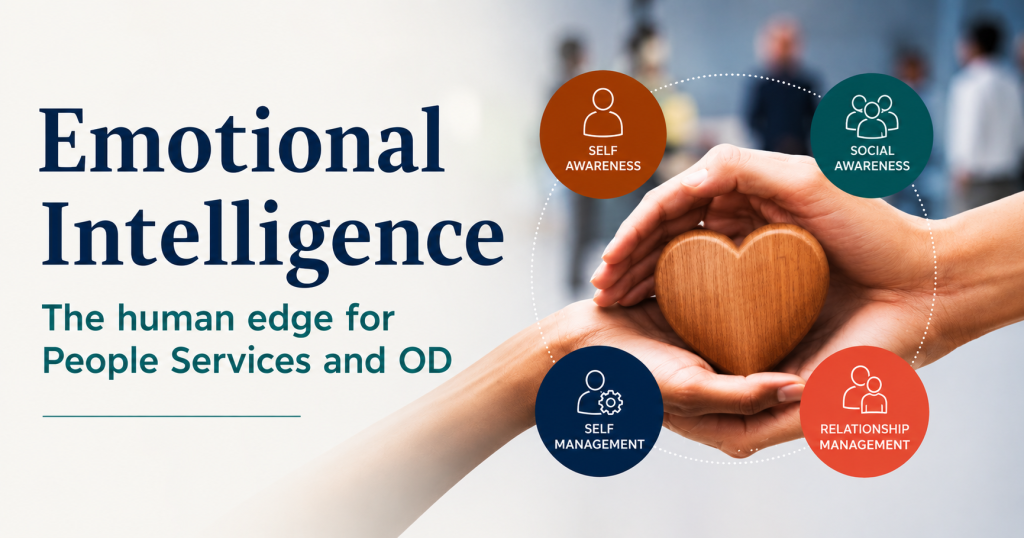
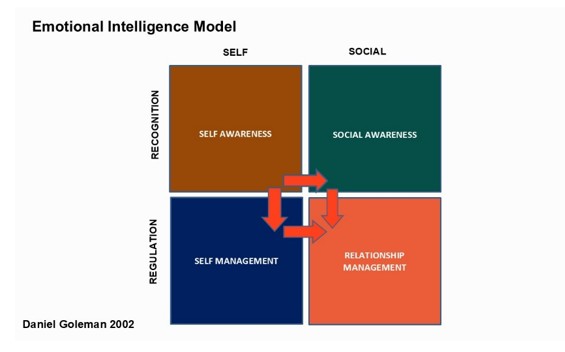
This is where emotional intelligence (EQ) matters. Goleman’s four domain EQ model – self-awareness, self-management, social awareness and relationship management- offers a practical framework for making sense of human needs in a world that prizes efficiency but still depends on trust, judgment and human connection.
As more task-focused work becomes automated, the emotional and relational work becomes more, not less, important.
For people services and OD professionals, that means emotional intelligence is not a soft extra. It is part of the job. It starts with us, and we model it for others in how we show up, how we notice and navigate our emotions and how we help teams stay connected when everything around them is accelerating.
Self-awareness
Self-awareness is about noticing what is happening in us as it happens. It means recognising our thoughts, emotions, body signals and habitual reactions, then getting curious about the values, assumptions or fears sitting underneath them.
In people services and OD, this matters because we are often working in emotionally charged territory of change, restructures, conflict, stretched managers, political pressure and anxious teams. If we are unaware of our own triggers, we are more likely to react from habit – rescuing, defending, shutting down or smoothing over too quickly – rather than responding with objectivity.
This is the first challenge in an AI-shaped world. When pace increases, reflection often decreases. Yet the faster things move, the more important it becomes to pause and ask: what am I noticing in myself right now, and what impact am I having on others?
Self-management
Self-management is what we do with that awareness. It is the capacity to regulate ourselves, stay with discomfort and choose a response that fits our values rather than our first impulse.
For people services and OD professionals, self-management is visible in the small moments that shape bigger outcomes: pausing before replying in a heated meeting, slowing the tempo when tension rises, holding boundaries under pressure and resisting the urge to fix everything too quickly. These are not minor interpersonal skills. They are part of how we create steadiness in systems that are often overloaded and emotionally reactive.
This also has a modelling effect. Managers learn as much from how we work as from what we say. If we can stay grounded in ambiguity, recover when we are triggered and look after our own energy over time, we give others permission to do the same.
Social awareness
Social awareness is about reading the emotional climate around us. It includes empathy, perspective-taking and the ability to sense what is happening in a team or wider system, not just what is written in the formal update.
This is especially important in workplaces experiencing rapid change, sharper polarisation and increasing conflict. Under strain, people can become more defensive, less curious and quicker to make assumptions about one another. Teams can split, conversations can harden, and important voices can disappear.
People services, and OD professionals can help leaders counter that drift by asking better questions: What is the mood in this team? Who is not speaking? What might people be worried about but not naming? How is stress narrowing empathy, attention and perspective?
Social awareness is about understanding the system well enough to intervene wisely. It helps us notice what sits beneath resistance, where trust is thin and what conditions people need in order to stay engaged and work well together.
Relationship management
Relationship management is where emotional intelligence becomes visible in culture. It is about how we communicate, influence, give feedback, handle conflict, repair trust and help people stay in relationship when the pressure is on.
As public services chase efficiency and delivery, relationships can easily be treated as secondary. Yet when conflict is ignored, feedback is poorly handled, or trust is allowed to fracture, performance suffers anyway and often at a far greater cost.
People services, and OD professionals have a key role here. We can create spaces where difficult conversations are practised, not avoided. We can support managers to develop their own EQ and relational leadership skills, supporting teams to name tensions before they turn into entrenched divisions.
In an AI world, this is part of the human edge. Technology can support the process, but it cannot do the relational work of staying present, owning impact, repairing rupture and helping people reconnect. That work still belongs to us, humans.
Emotional intelligence gives people services and OD professionals a practical framework for doing that work well. In a faster, more polarised and more pressured environment, the real challenge is not simply to keep up. It is to help organisations stay human while they change.
- When the pace and pressure rise, what are you modelling emotionally, and what one small shift could you make?
- In relation to a team/manager you support – What is one small change in how you listen, respond or communicate that could make the biggest difference right now?
Gayle Hudson June 2026

Is an Associate with The Staff College and leads the “Emotionally Intelligent Leadership” programme