Hello PPMA members and friends
As Director of People and Governance for Brentwood Borough Council and Rochford District Council, and Vice President of PPMA, Nichola Mann has been at the sharp end of local government reorganisation (LGR).
Since 2022, the two Essex councils have worked together through a strategic partnership, bringing services and teams together and sharing parts of their workforce, despite not sharing an administrative boundary.
But under the original LGR proposals, the two councils were destined to become part of different unitary authorities, raising the prospect of separating a workforce they had spent years bringing together.
With the Government’s latest announcement bringing another development in an already uncertain journey, Nichola shares her personal reflections on the challenges of leading people through change, supporting HR teams and finding opportunities amid the uncertainty.
Imagine spending several years bringing two councils and their workforces closer together, only to find yourself planning how to separate them again.
That’s the unusual position we found ourselves in at Brentwood and Rochford as local government reorganisation gathered pace across Essex.
A big part of our partnership journey has been about people and culture. We’ve learned a great deal about bringing teams together, creating shared values and ways of working, and developing a sense of One Team supporting two councils. Our One Team values were themselves developed by employees from across both organisations.
Looking back, that experience gave us valuable foundations when LGR arrived. We already understood that changing structures is one thing, but bringing people with you and creating a shared culture takes time.
Under the five-unitary model originally selected for Greater Essex, Brentwood and Rochford were due to become part of different new unitary authorities. Brentwood would join Chelmsford and Maldon, while Rochford would join Castle Point and Southend.
So there was a certain irony that, having spent several years bringing our two councils and parts of our workforce closer together, we were now having to think about what it might mean to separate that shared workforce and support people into two new organisations.
Planning for a future that keeps changing
We moved into some quite detailed workforce planning: workforce data, critical roles, policies, pay and terms and conditions, equal pay, organisational design, culture and what being safe and legal on day one would require.
Then, on 7 September 2026, the position changed significantly. The Government withdrew its previous decision for Essex, Southend-on-Sea and Thurrock and announced a rapid review of the wider LGR programme.
For those of us who had already spent months preparing for implementation, it was quite a moment.
I remember the immediate conversations after the September announcement: What does this mean? What do we tell people? What happens next?
There were lots of questions and not many answers.
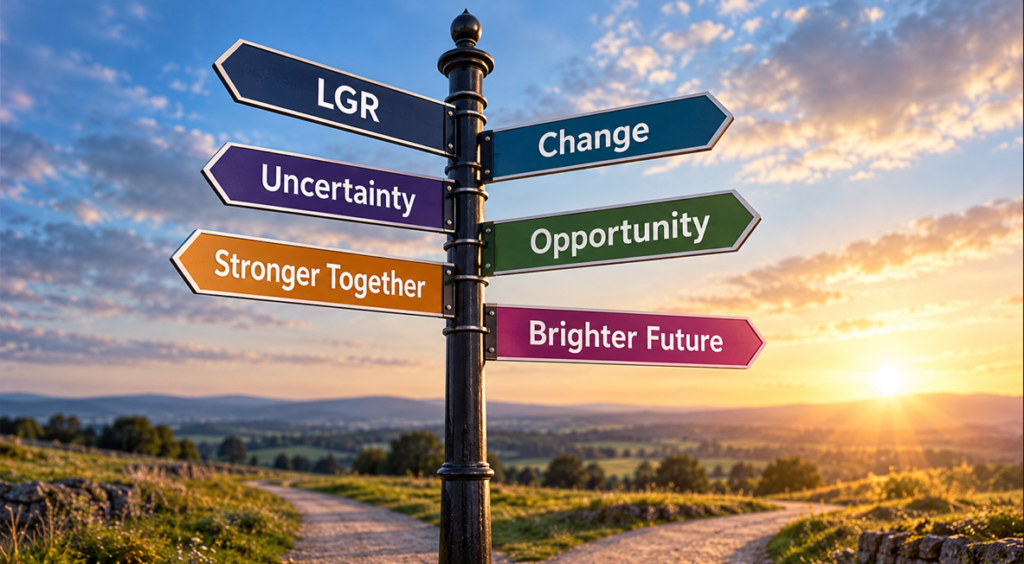
When I look back over the last few months, the word that comes to mind most often is uncertainty.
Change is nothing new in local government, particularly for those of us working in HR and OD. But LGR has felt different because we have sometimes been trying to plan seriously for a future when the destination, timetable and route to get there have continued to move.
Perhaps one of my biggest lessons has been that leadership isn’t always about having the answers. Sometimes it is about being comfortable enough to say “I don’t know yet”, while giving people confidence that we will navigate what comes next together.
Remembering the people behind the plans
When you work on LGR every day, it is easy to find yourself talking about structures, workstreams, implementation plans and vesting days.
For employees, the questions are much more personal.
Will I still have a job? Who will I work for? Where will I be based? What happens to my team? What happens to my terms and conditions?
Behind those questions are people’s careers, families and sense of security.
Our approach has been to be as honest as we can. I would rather say that we don’t know something yet, than offer reassurance that we might later have to retract.
I’ve also been struck by how differently people experience the same change. For some, a change in direction may bring relief. Others may already have started looking forward to the opportunities a new organisation could bring.
One person’s relief can be another person’s disappointment.
It’s an important reminder that there isn’t a single workforce reaction to change, and we need to be mindful of that when communicating with and supporting our people.
Supporting others while experiencing the change ourselves
HR teams are expected to provide stability during uncertainty, but we are not standing outside the change. We are part of it too.
At the same time as preparing for significant workforce transformation, the day job continues. People still need to be recruited and paid. Managers and employees still need support. Services still need to be delivered.
One of my strongest reflections is that you cannot endlessly add transformation activity on top of business as usual and simply assume people will absorb it. We have to be realistic about capacity, priorities and pace, including within our own HR teams.
I’ve found it helpful to ask a simple question about our LGR work:
Will this make us a better organisation whatever happens next?
Better workforce data, understanding our critical roles, reviewing policies, succession planning and developing our people haven’t suddenly lost their value because the destination may have changed.
For me, that is the real value of no-regrets work.
Learning from each other
One of the positives of this period has been the opportunity to learn from HR and OD colleagues who are going through LGR now, as well as those who have already experienced reorganisation.
We held a really positive LGR workforce workshop with PPMA and Solace, bringing together colleagues from different authorities. What struck me wasn’t just the differences between our experiences but the similarities. Different places, different structures and different stages of the journey, but many of the same people and workforce challenges.
You can have the best project plan in the world, but there is something incredibly valuable about talking to somebody who has actually been through reorganisation. Hearing what worked, where the pressure points emerged and what they would do differently has really helped our thinking.
Something else positive has happened too.
We have built relationships.
Locally across Essex, LGR brought us into much closer contact with colleagues across other councils. We spent more time talking, sharing experiences and understanding each other’s organisations, challenges and strengths.
We have also built relationships with HR and OD colleagues elsewhere in the country who were originally travelling through LGR at a similar time to us. Although our local circumstances may be different, many of the workforce questions have been remarkably similar.
Having colleagues and professional networks such as PPMA to turn to, share experiences with and learn from has been particularly valuable during this period.
I don’t think any of that has been lost because our timetable or direction has changed.
If anything, this process has created connections that we might not otherwise have developed. Across Essex, we understand each other better and have started conversations about opportunities to collaborate that don’t necessarily depend on a particular LGR structure.
Whatever the next chapter brings, I hope we continue to build on those relationships.
The destination may have changed, but the relationships, learning and opportunities to work together remain.
What have I learned?
If I were talking to an HR colleague beginning their own LGR journey, a few things stand out:
- Don’t wait for perfect certainty. It may never arrive.
- Be honest when you don’t know. False certainty damages trust.
- Get the basics right early. Workforce data, critical roles, policies, pay and terms and conditions matter.
- Keep communicating. Silence is quickly filled by speculation.
- Think about today’s workforce as well as tomorrow’s organisation. People still need to feel invested in and valued.
- Learn from people who have done it before. Their hindsight is invaluable.
- Build relationships. They may prove useful far beyond LGR.
- Look after your HR team. The people supporting everyone else need support too.
Whatever comes next
I think my reaction to the latest developments is that it is helpful to have a next step, but I have learned not to mistake a next step for certainty.
So rather than simply switching everything back on and racing towards another date, I think there is value in taking stock.
What worked? What didn’t? What have we learned? What would we do differently? What should we continue doing anyway? And perhaps most importantly, what have we built along the way that we don’t want to lose?
For me, one of the biggest lessons has been this:
Our job in HR isn’t always to remove uncertainty, because sometimes we simply can’t. Our role is to create as much honesty, clarity and stability as we can within it, while remembering that we are human and experiencing the change too.
And whatever the next chapter brings, the relationships we have built, the things we have learned from each other and the opportunities we have found to work together will continue to have value.

Nichola Mann, Director of People and Governance for Brentwood Borough Council and Rochford District Council, and Vice President of PPMA